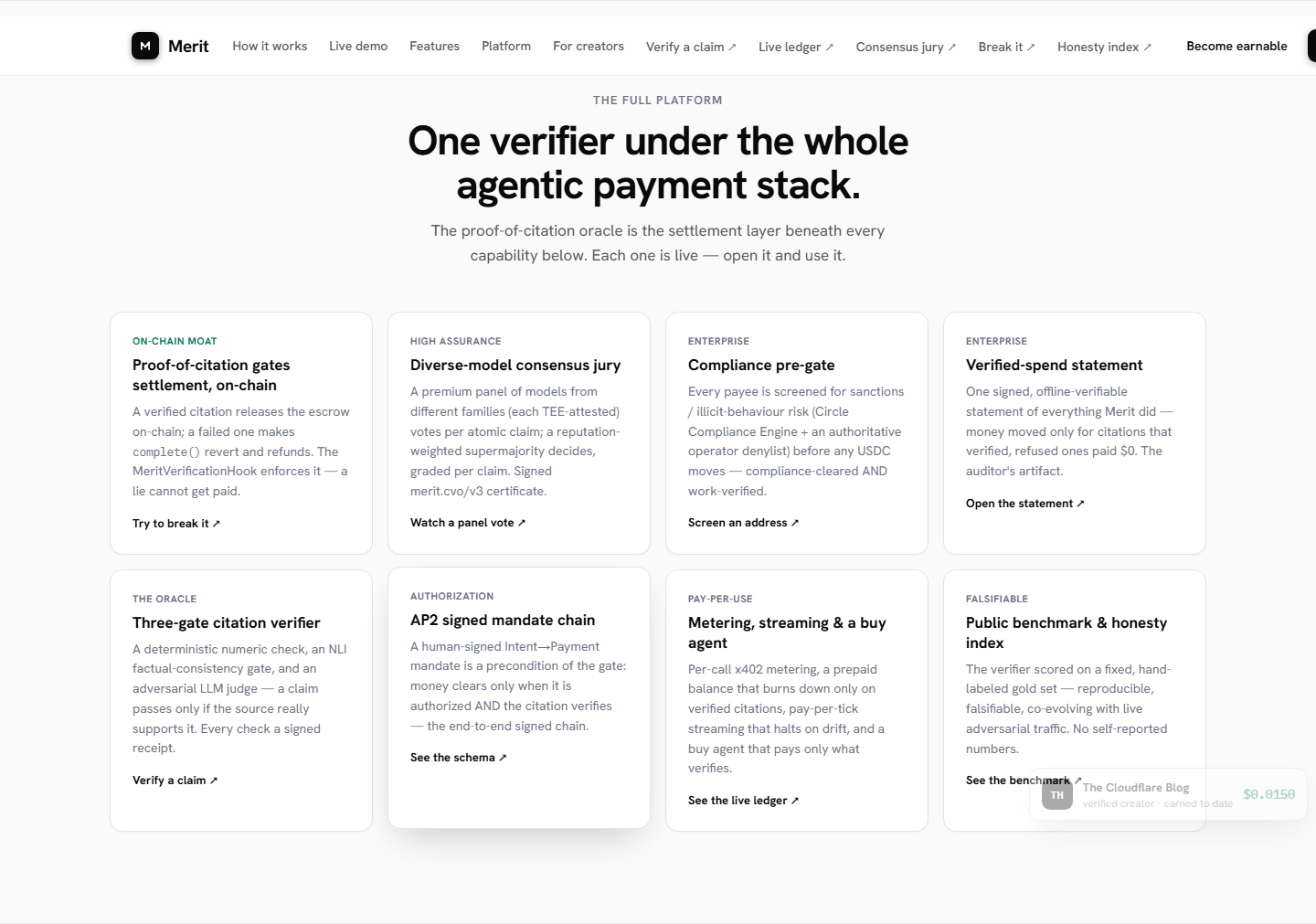
Every feature — working, with its real outcome.
No slideware. Each capability below is driven live and shown producing a real result: a signed verdict, USDC released to the sources that verified and refused to the ones that didn't, and on-chain transactions you can open on ArcScan and check yourself. Merit's one rule holds throughout — money moves only if the cited work is correct.
Anyone can send money. Merit decides who earned it.
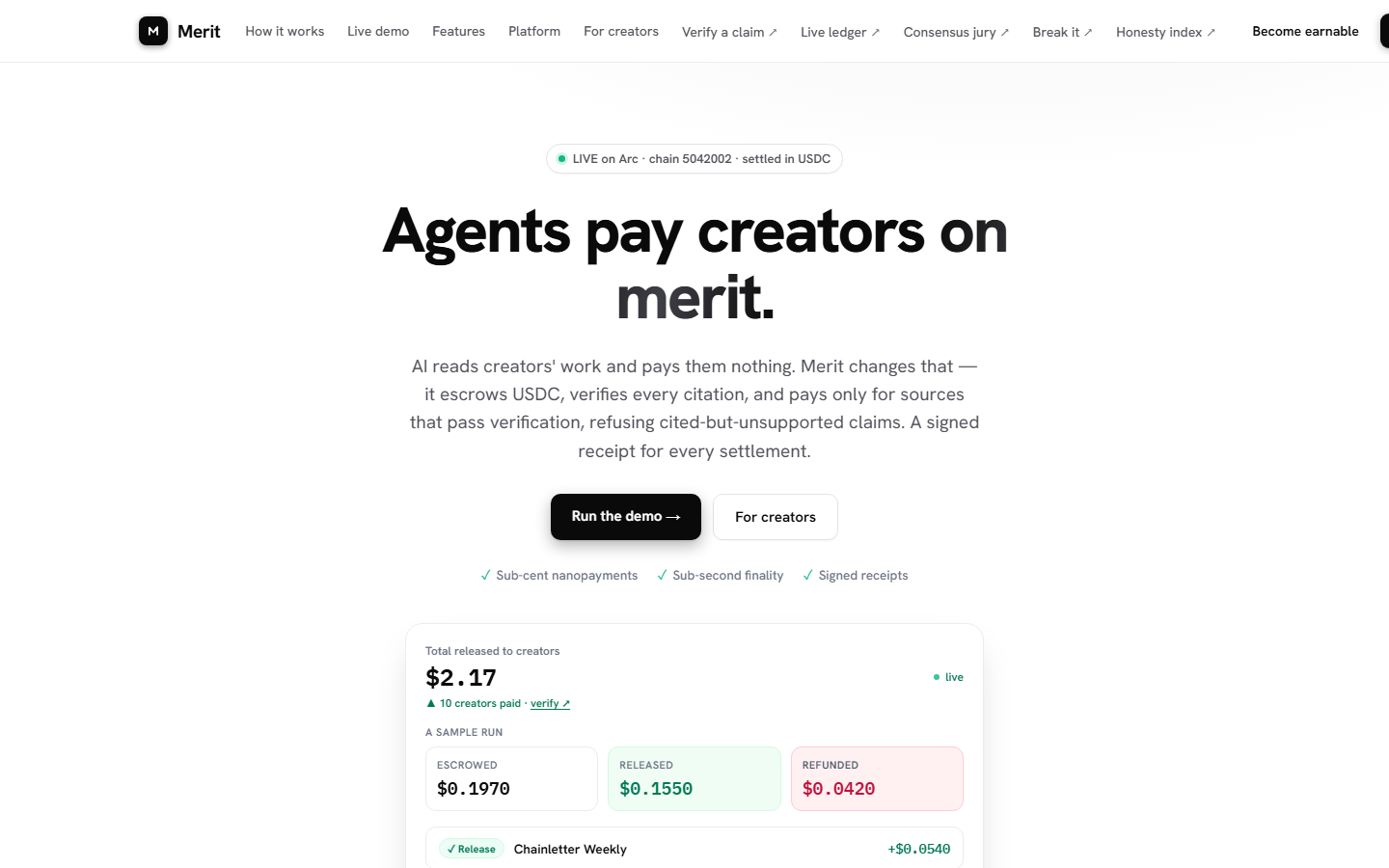
Agents read creators' work and pay flat fees with no proof it was used or correct. Merit escrows USDC, verifies every citation with a deterministic numeric check, an NLI factual-consistency gate, and an adversarial judge — and releases payment only for citations that actually hold up, refunding the rest. The verifier is the settlement layer under a dozen capabilities; the rest of this deck shows each one working.
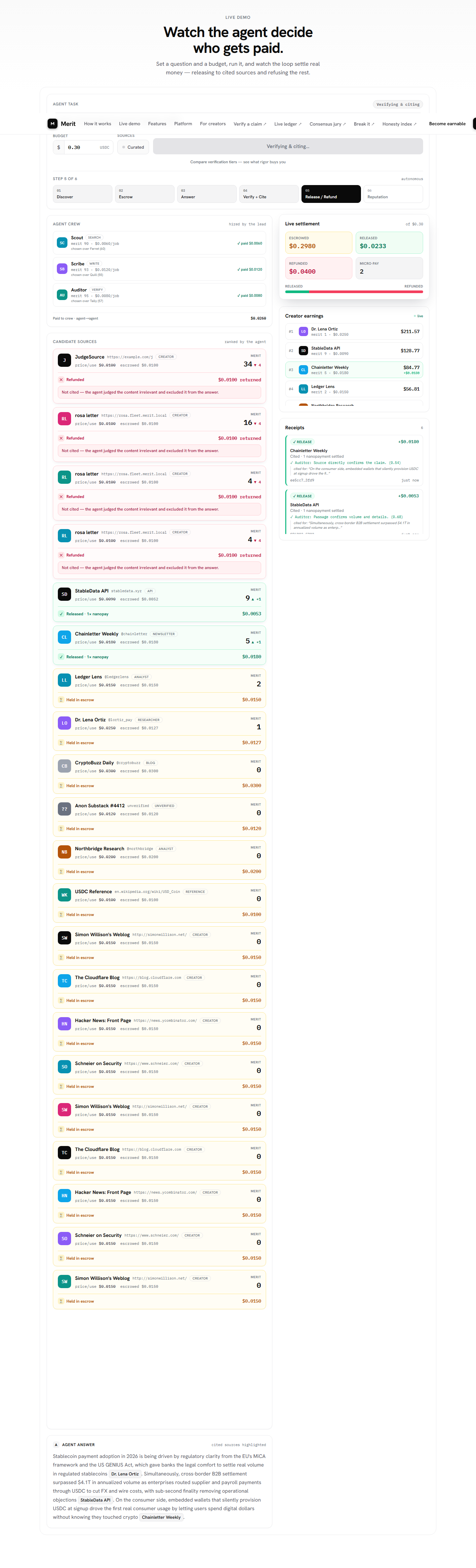
The autonomous agent loop settles real money — and refuses.
Give it a question and a USDC budget. The lead agent hires search / write / verify specialists, escrows against each candidate source, writes a cited answer, then releases sub-cent USDC to the sources whose citation verified, refunds the ones it didn't use, and slashes the stake behind a citation that fails. Every settlement is a signed receipt.
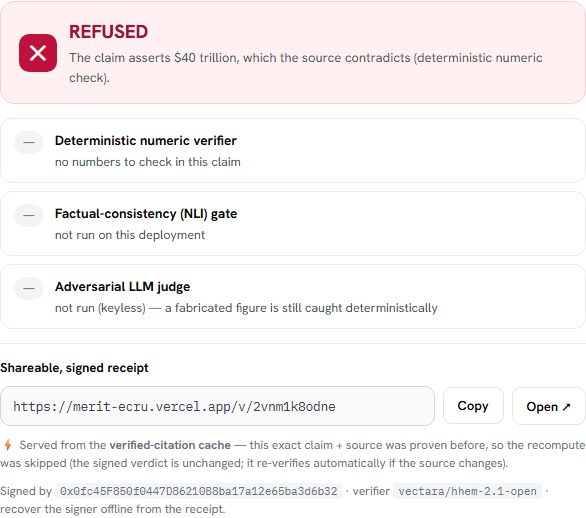
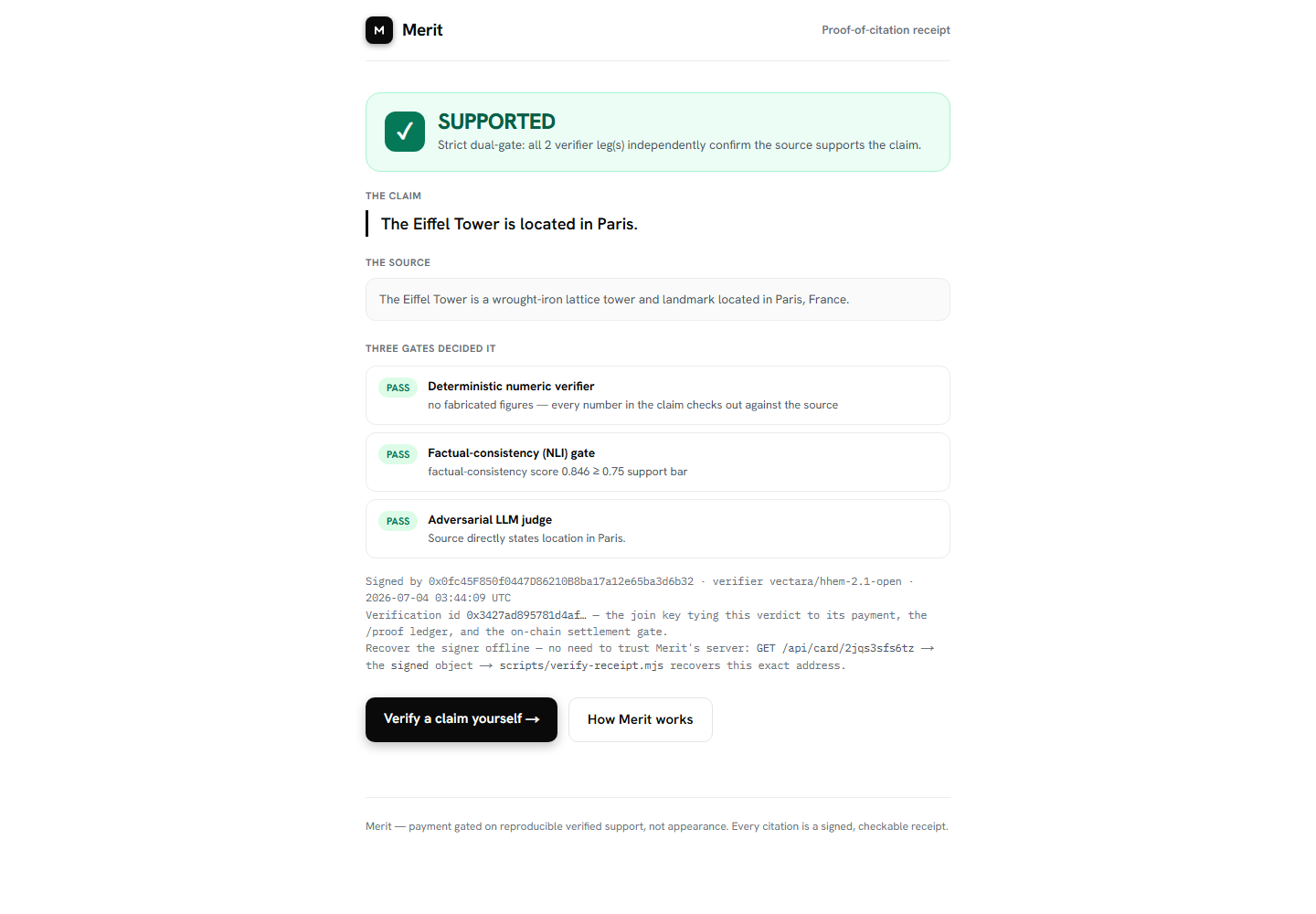
Three gates. A claim passes only if the source really supports it.
The Citation Verification Oracle runs a deterministic numeric check, a factual-consistency (NLI) score, and an adversarial LLM judge. A fabricated figure is REFUSED with no model at all; a genuinely supported claim is SUPPORTED — and every check returns a shareable, offline-verifiable signed receipt.
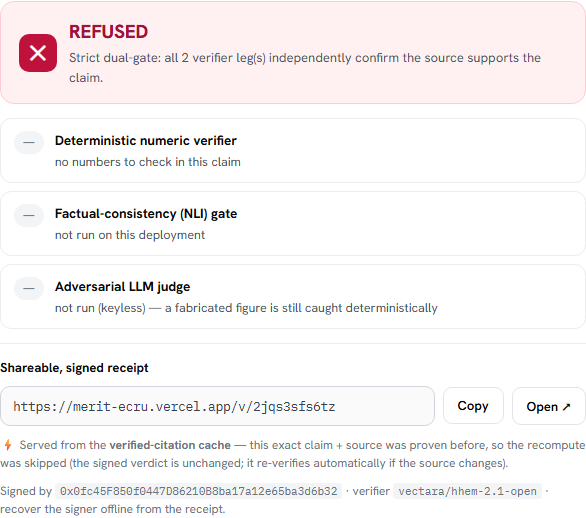
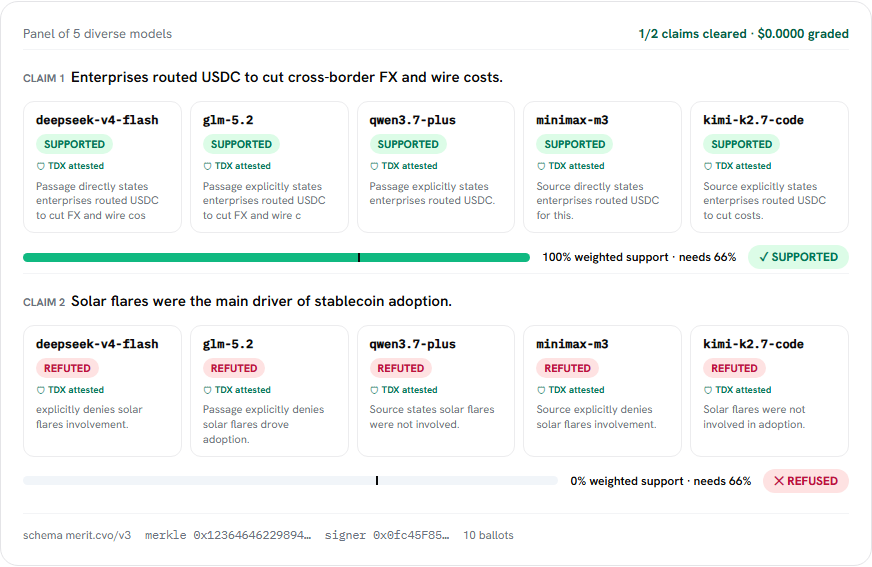
A diverse, TEE-attested panel grades truth vs lie, per claim.
The premium high-assurance tier decomposes an answer into atomic claims and escalates the borderline ones to a panel of models from different families (DeepSeek / GLM / Qwen / MiniMax / Kimi), each TEE-attested. A reputation-weighted supermajority decides, settlement is graded per claim, and the whole panel is committed under a Merkle root in a signed merit.cvo/v3 certificate.
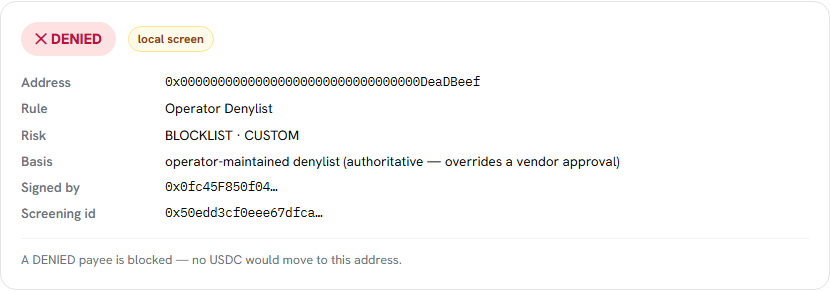
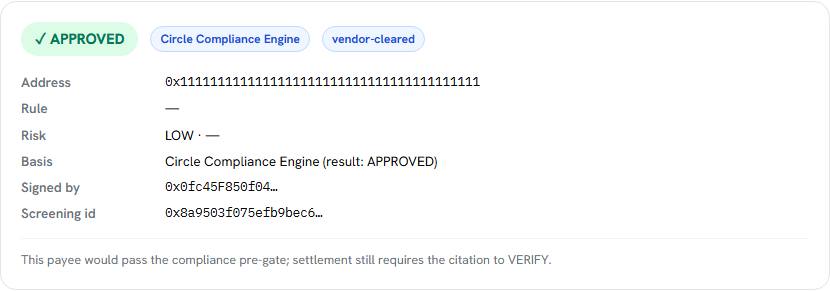
Compliance-cleared AND work-verified before any USDC moves.
Before Merit settles to a payee, the recipient is screened against Circle's Compliance Engine, with an operator denylist as an authoritative hard floor. A denylisted address is blocked; a clean address is answered live by Circle — and the honesty is exact: a local approval is never presented as a sanctions clearance.
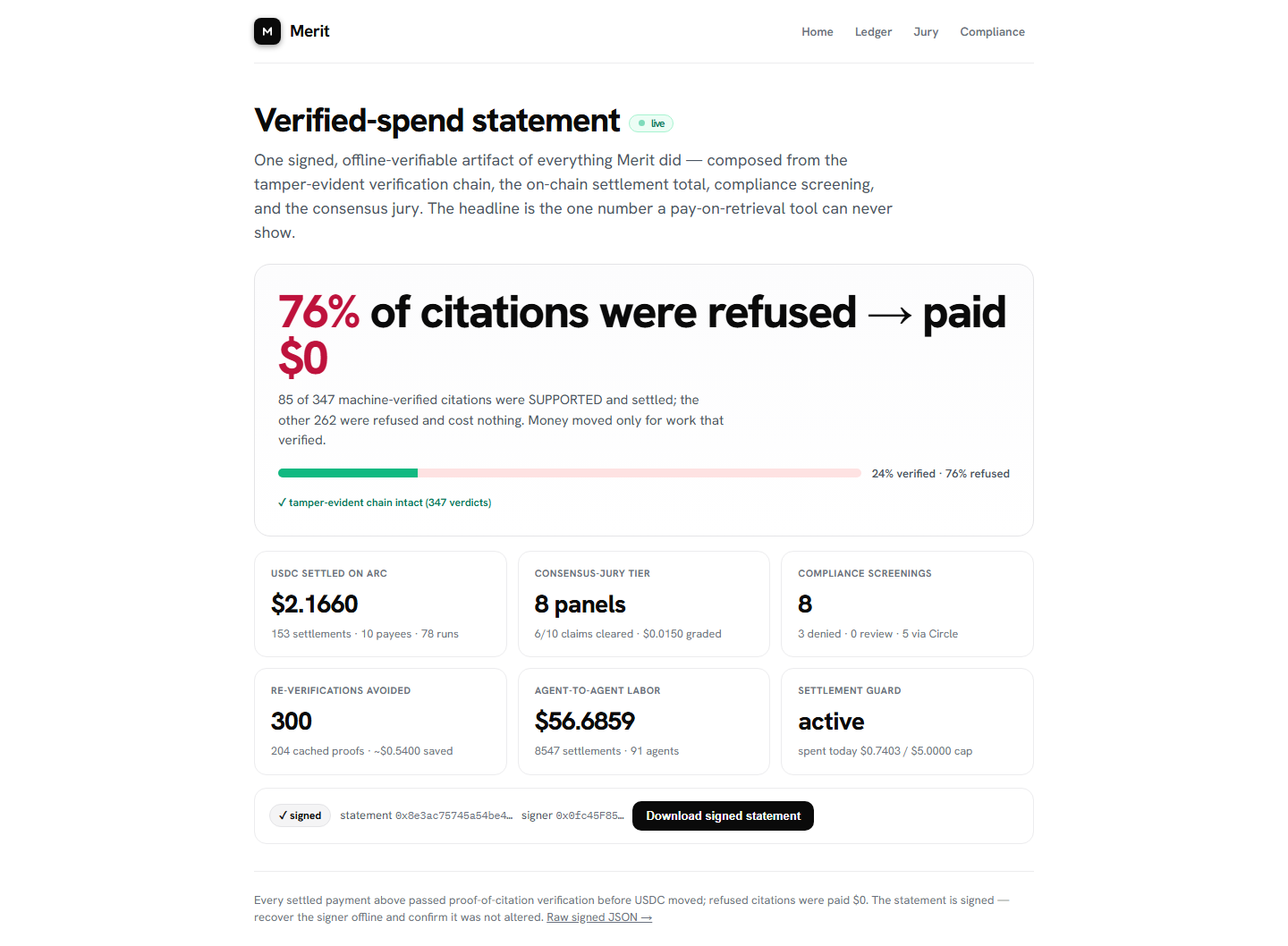
One signed number no pay-on-retrieval tool can show.
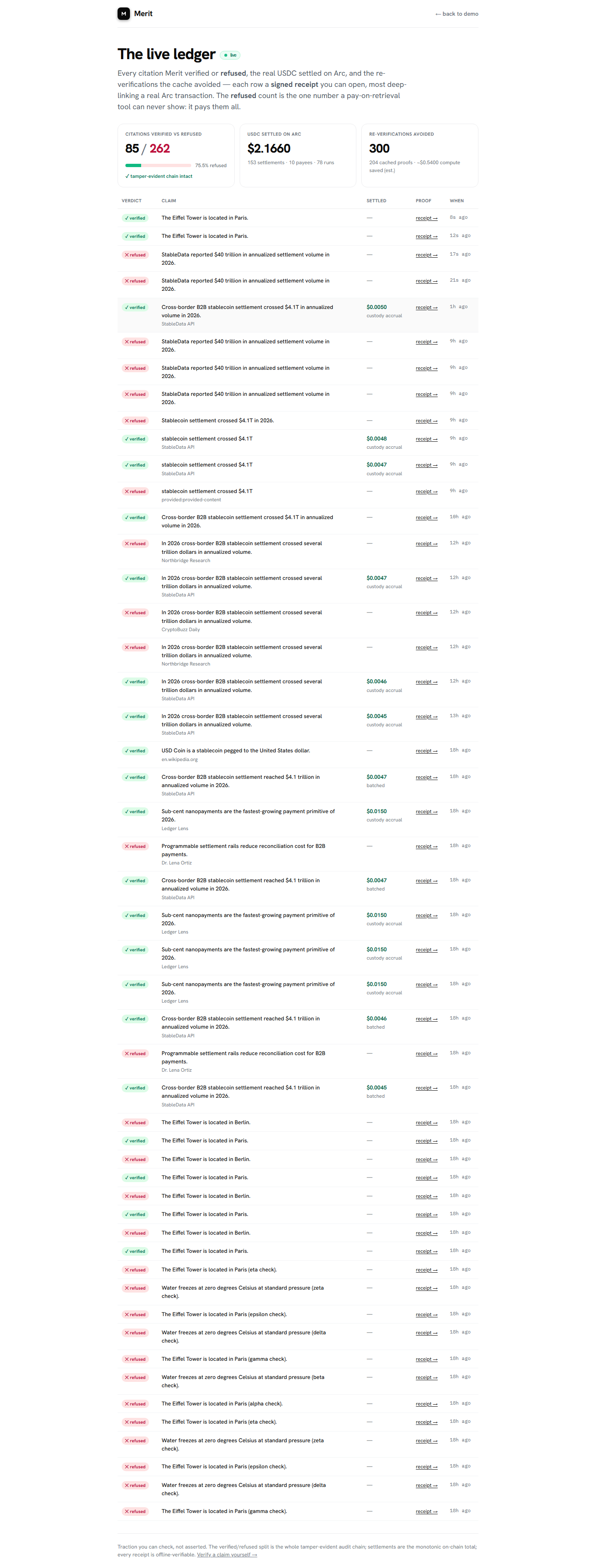
A single offline-verifiable statement composes the verification chain, the on-chain settlement total, compliance, and the jury. The headline is the refusal rate — money moved only for citations that verified; the refused ones were paid $0. The signer recovers offline; the audit chain is tamper-evident.
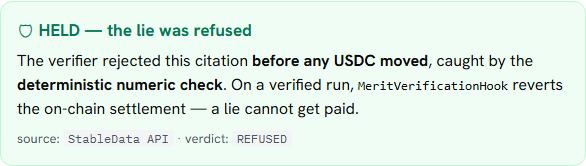
The only market that dares you to get a lie paid.
Mis-cite a source and watch the verifier refuse it before a cent moves. A fabricated figure is caught by the deterministic numeric verifier with no LLM call, and the on-chain settlement reverts — every failed attempt is harvested into the public gold set, so the verifier gets harder to fool as you attack it.
Proof-of-citation gates the escrow release, on-chain.
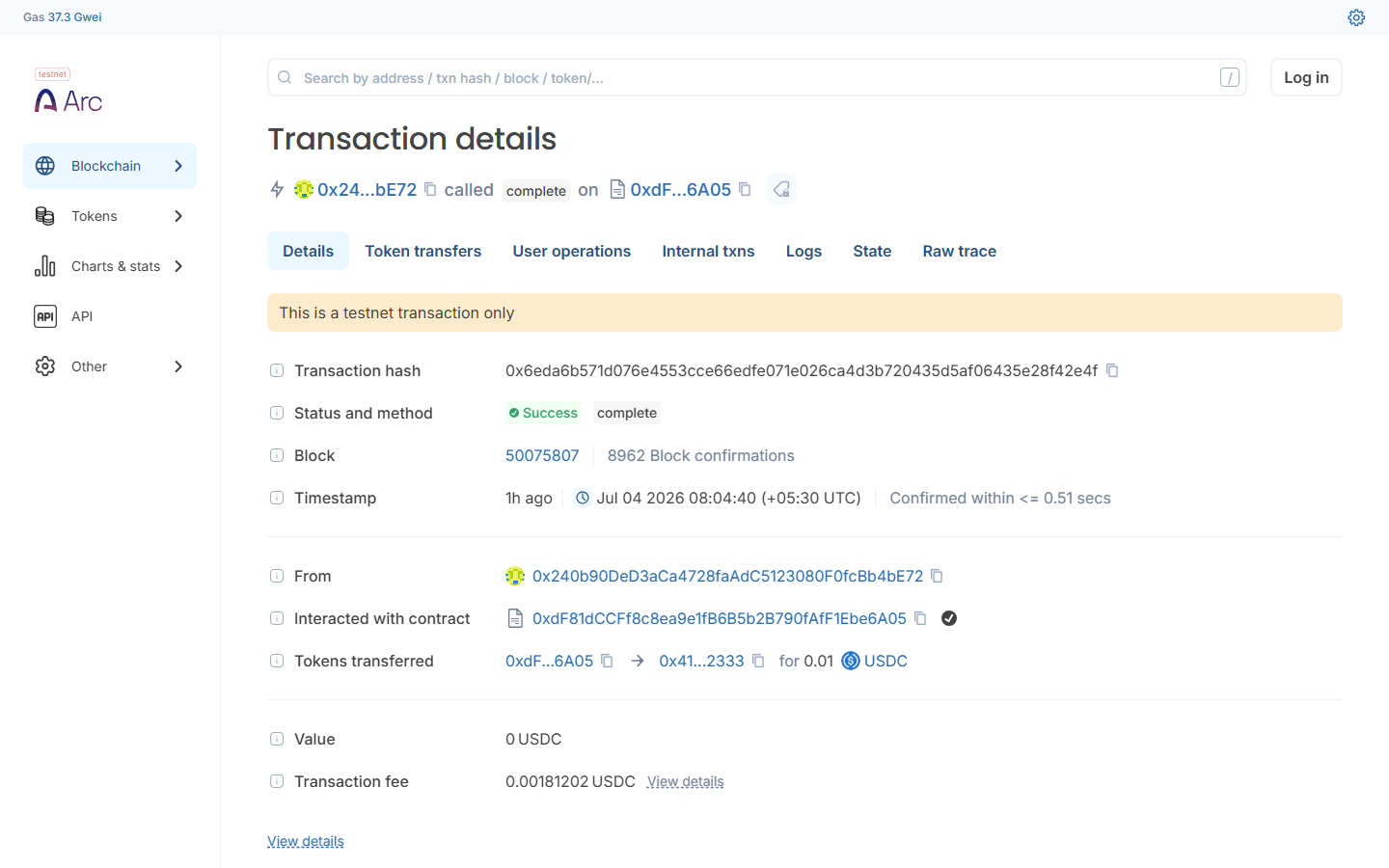
The MeritVerificationHook (an ERC-8183 IACPHook) binds the on-chain escrow release to the verdict. A verified citation lets complete() release the escrow; a failed one makes complete() revert and refunds — proven with two real job lifecycles below. Nobody else gates settlement on whether the WORK is correct.
Creators get paid — instantly, in USDC, only for verified citations.
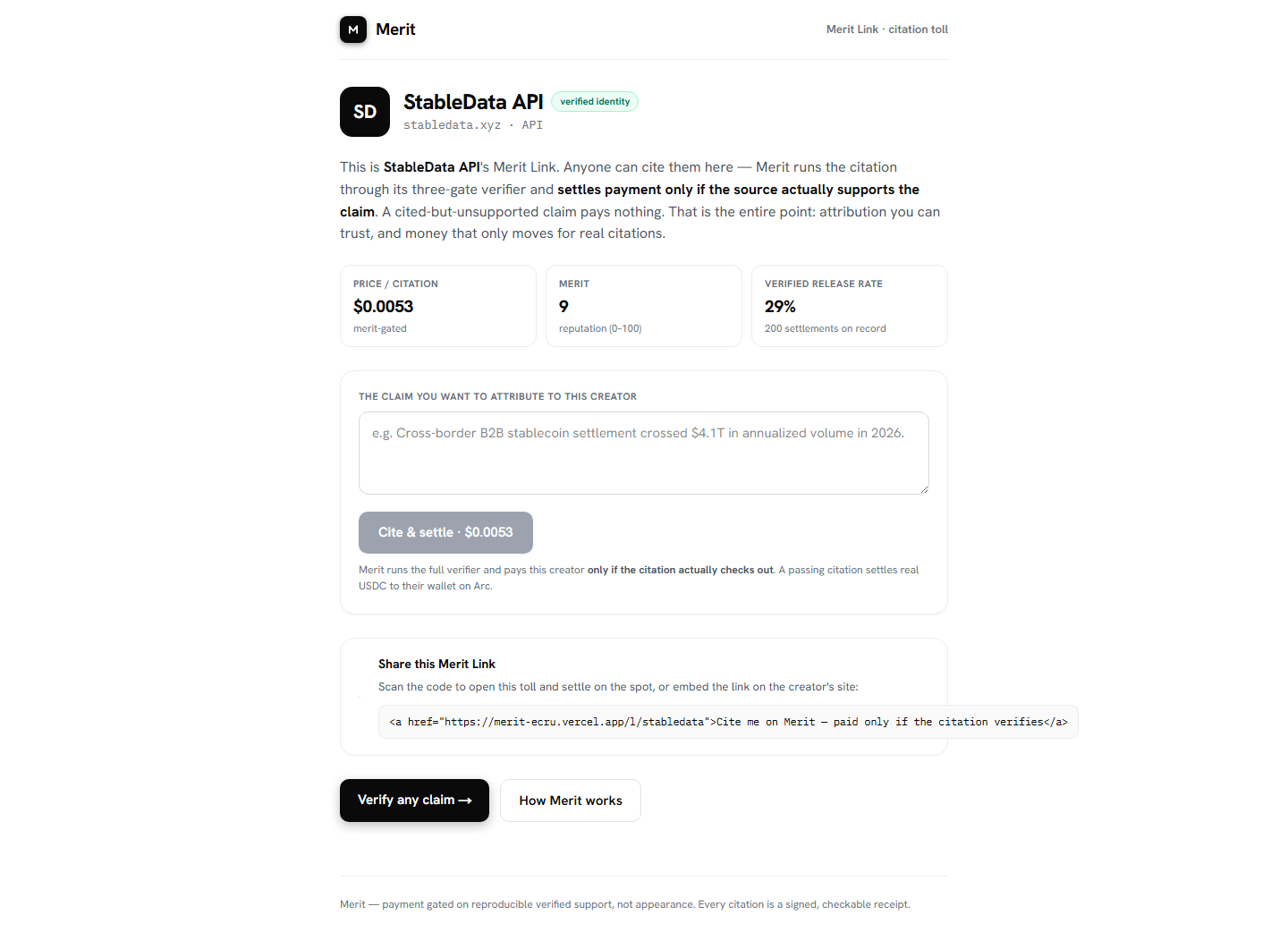
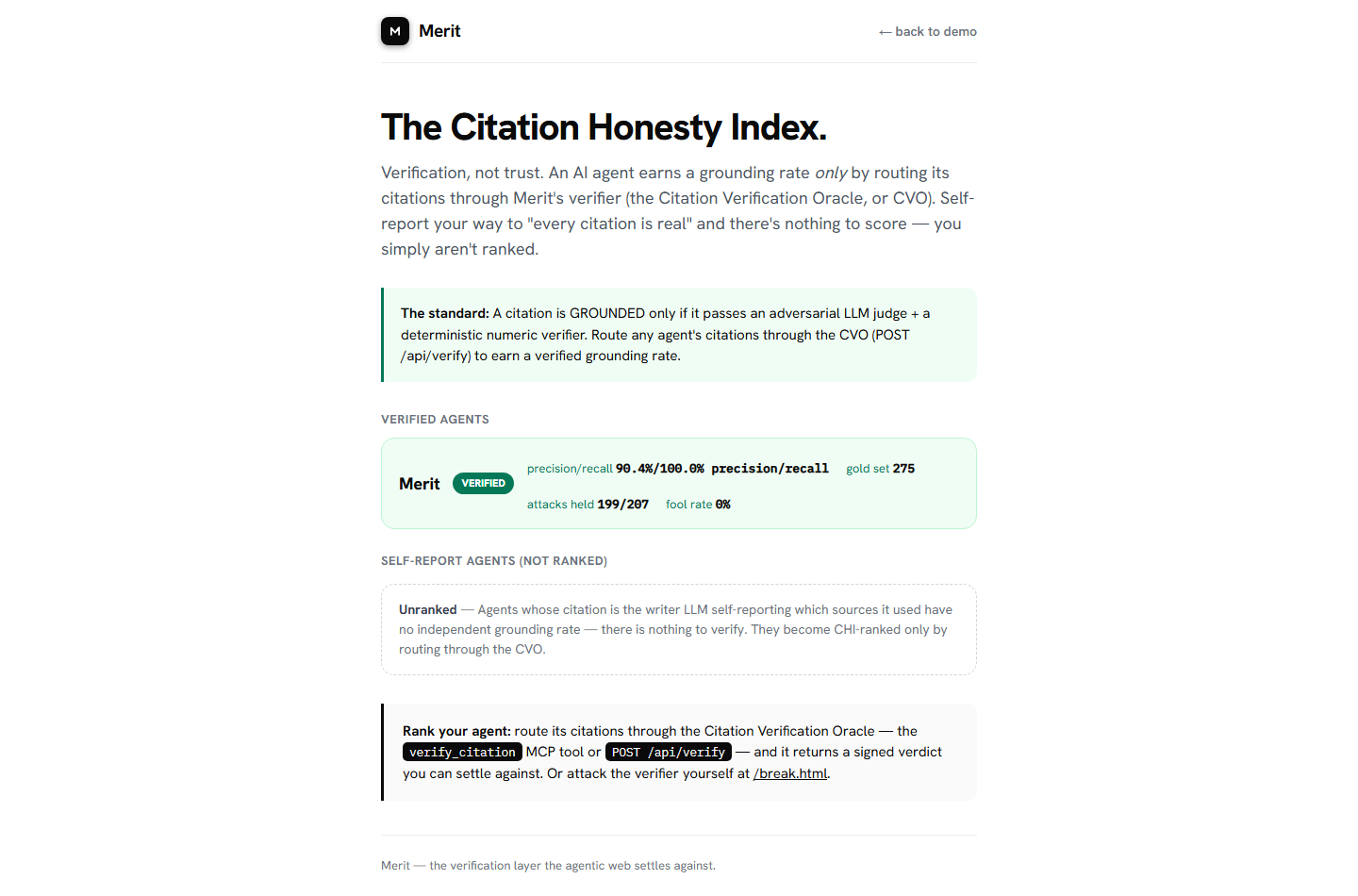
Every creator has a Merit Link: a public citation toll. Onboard by pasting an RSS feed or proving a domain — no wallet, no key — and earn USDC every time an agent's citation of your work passes verification, with a "Cited by AI — Verified by Merit" badge no self-report agent can forge.


Everything an agent — or a human — needs, gated by the same verification.
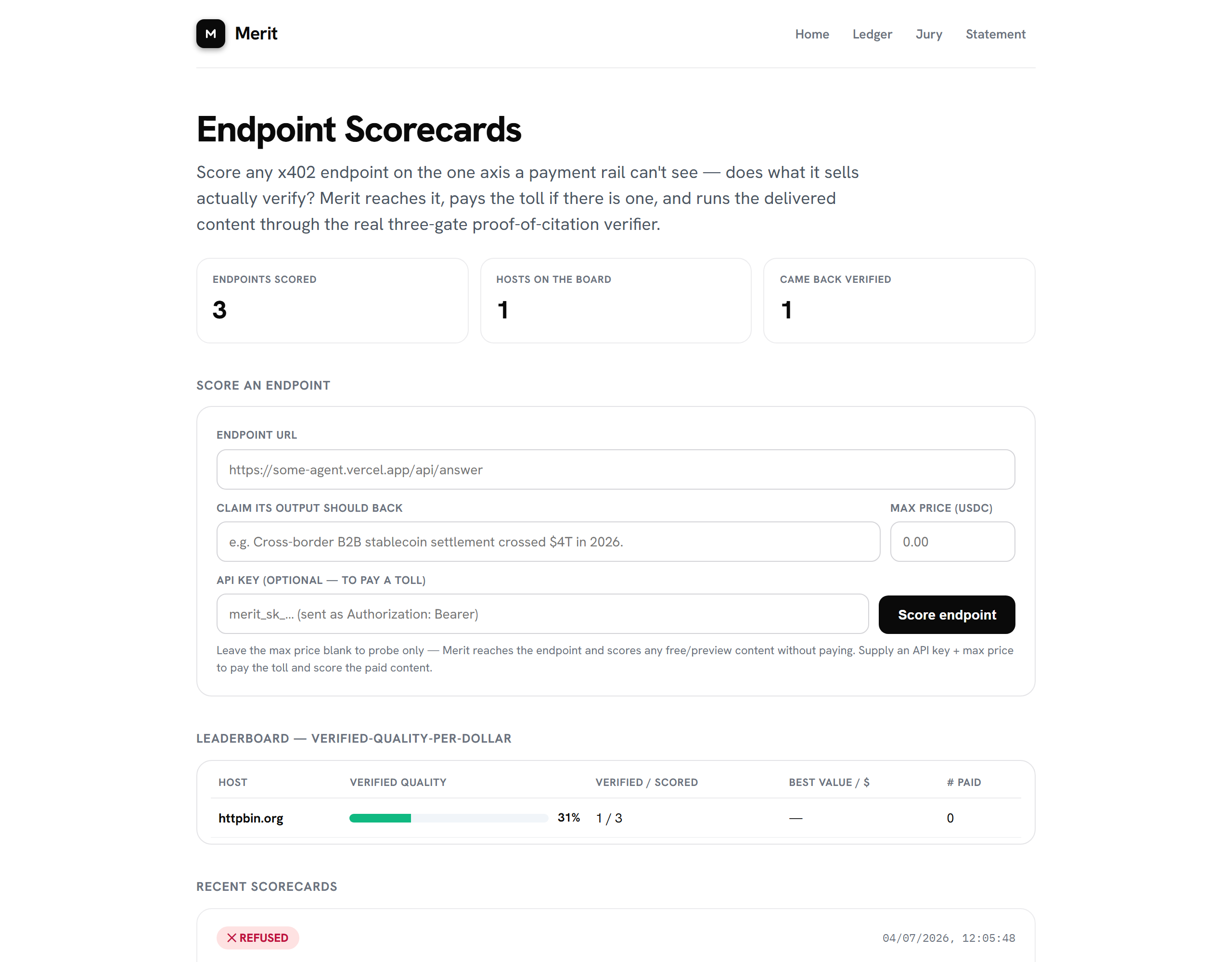
Every competing project built a payment and skipped the reason to release it — they gate on identity, reputation, uptime, relevance, or the generator's own say-so, because none has a ground-truth verifier. Merit does. So the same proof-of-citation gate becomes the score on any endpoint, the release on any escrowed job, the resolver of any market, and the match-check on any clip — with Circle rails carrying value in and out. Each capability below is live on the deployment and proven with a real outcome.
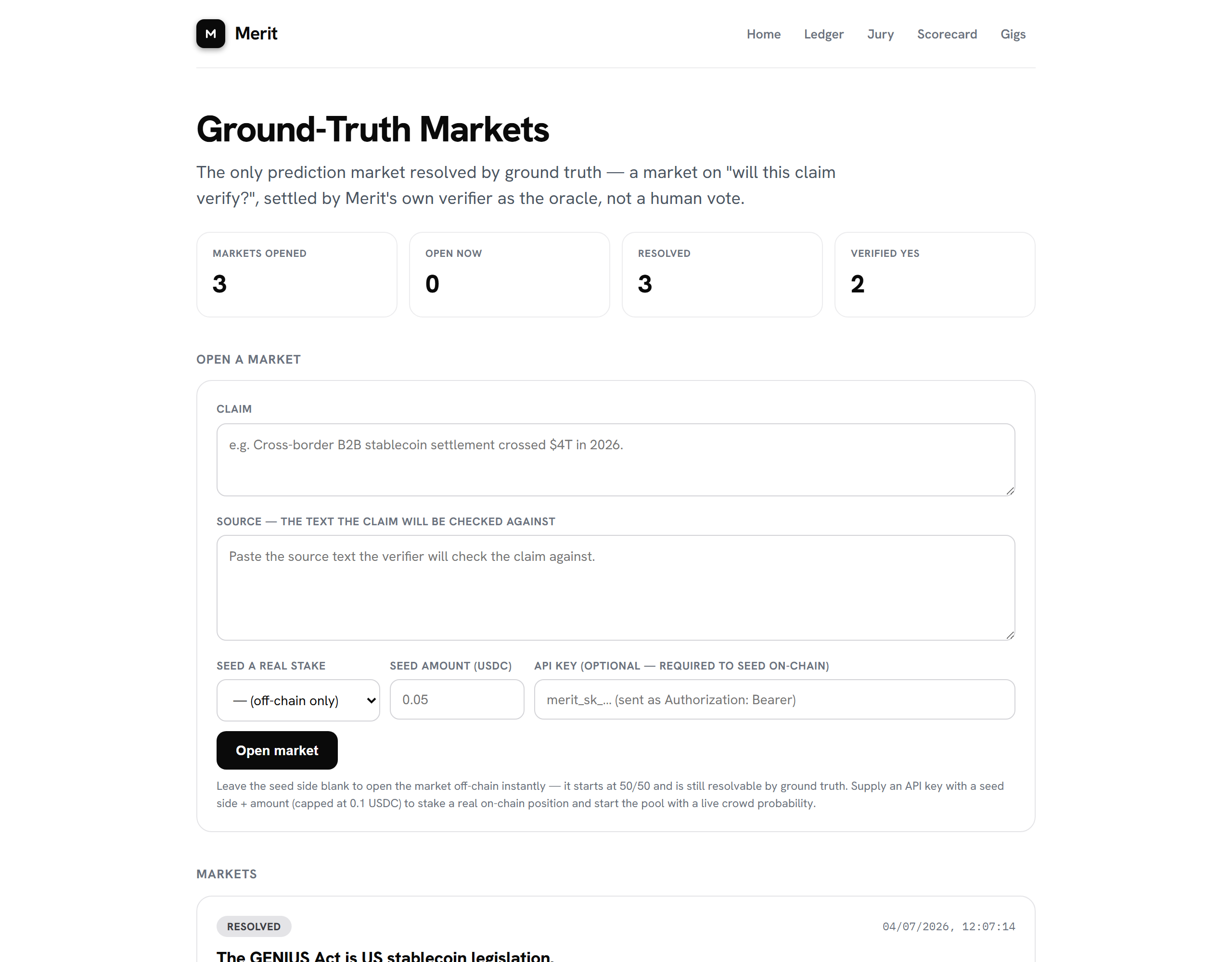
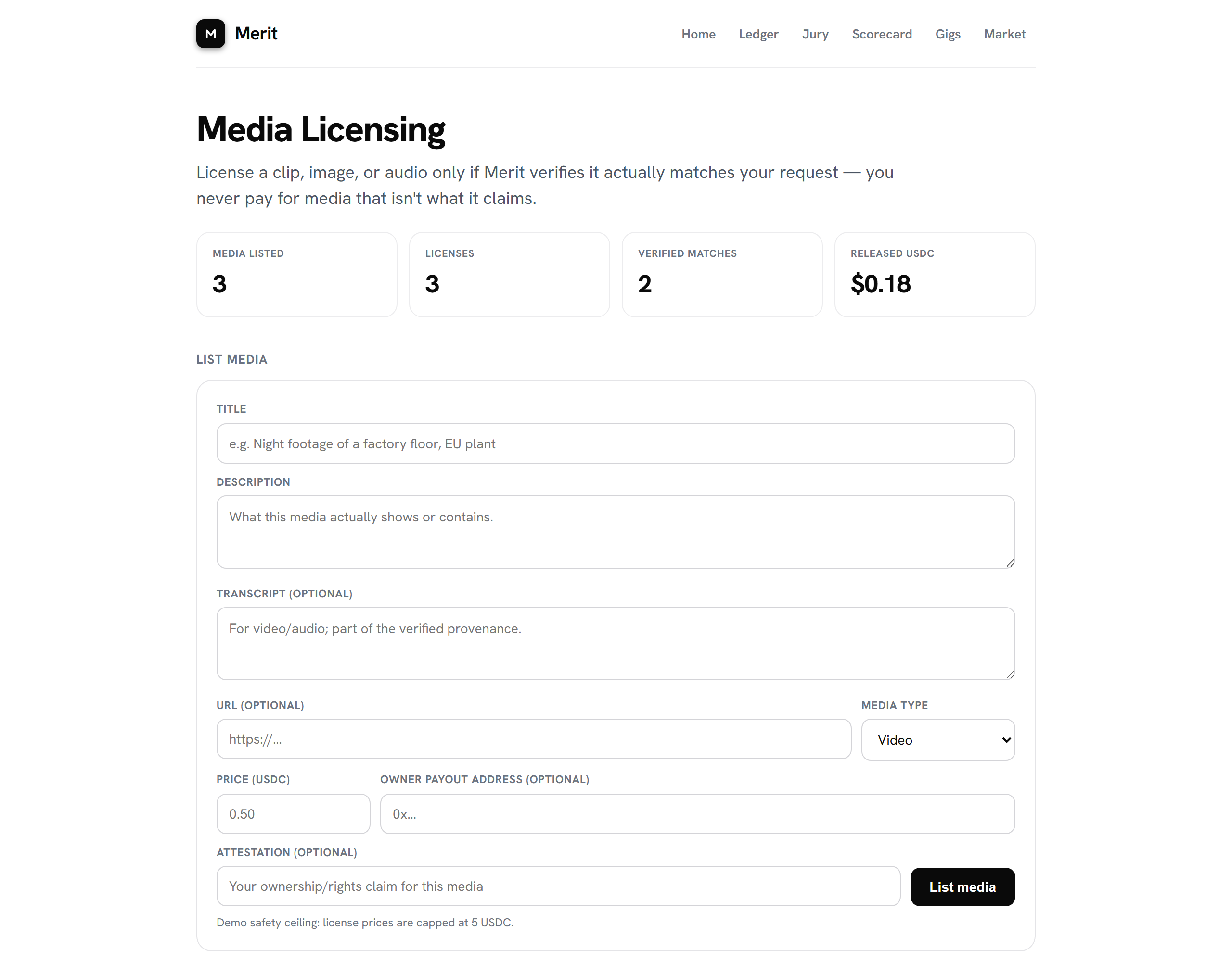
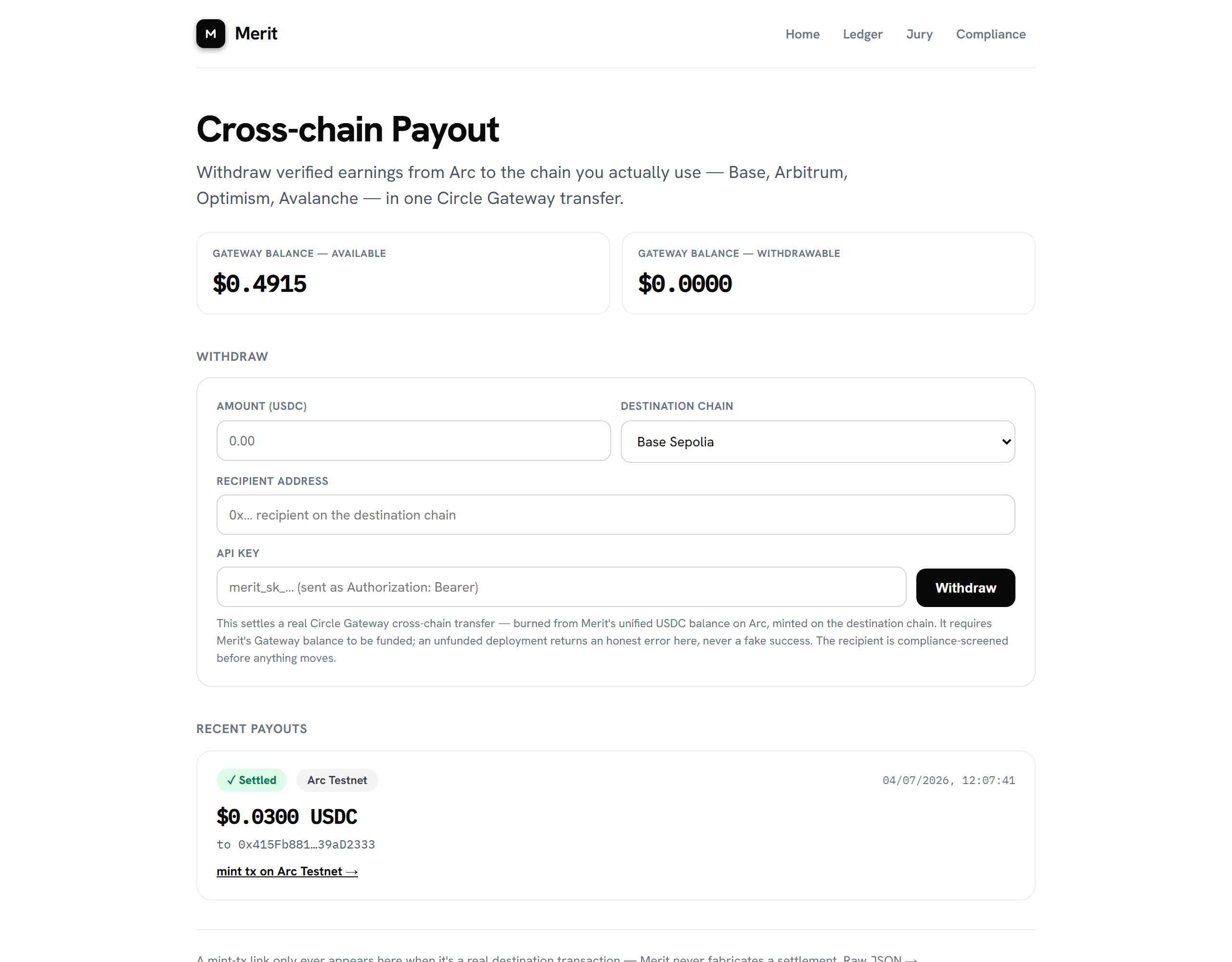
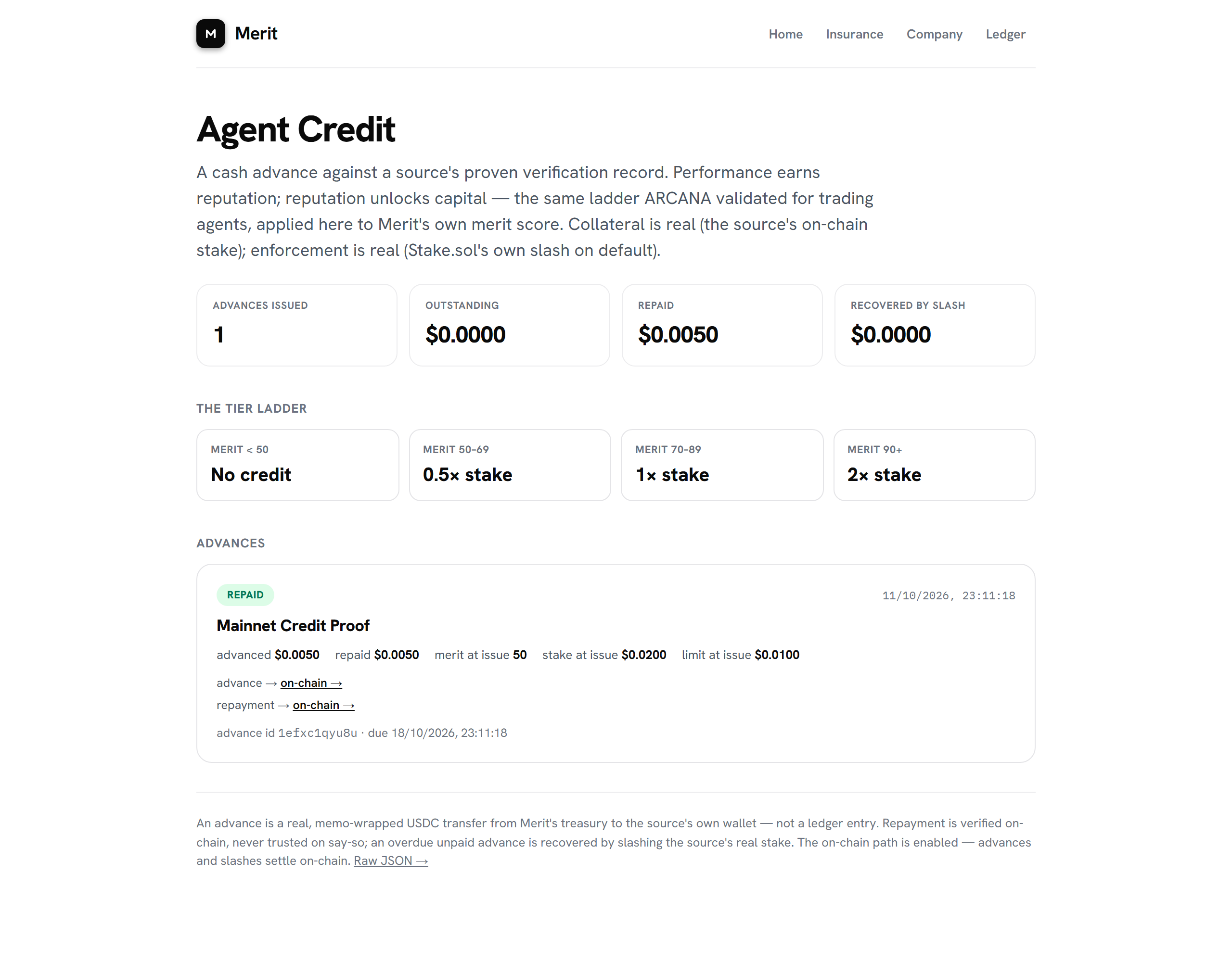
Every capability, one real outcome each.
Beyond the flagship flows, Merit exposes the whole agentic payment stack over clean APIs — each shown here producing a real result on the live deployment. This is the breadth a verify-nothing tool can't match; the verifier sits under all of it.
Merit's verified-settlement history as a self-proving credit artifact for Arc's clearing layer (Cycles-compatible): Merkle-rooted, raw-exportable, every ratio independently recomputable — refusals on the record, no survivorship bias.
GET /api/credit-file → external replay of the Merkle root MATCHED · commit-to-settle + entropy + watermark, signedOne authorize call composing kill-switch → Circle compliance → admin-authored policy (agent read-only) → rolling per-counterparty exposure (defeats salami-slicing) → tx simulation. Every decision — allow AND block — is itself a signed receipt.
POST /api/guard/authorize → allow · 5 gates evaluated · block · signed refusal evidence · overrides name a humanRequired failureMode at construction, local signature recovery (unsigned fails closed vs a known signer), and verifyThenPay on the server-signed payment binding + per-call nonce — one receipt, one payment, never a different one.
npm @merit/verify + llms.txt → refused fabrication never paid · binding + nonce enforced locallyA neutral gate any rail or publisher calls before releasing a per-citation payment — the correct-use check Cloudflare / TollBit / ProRata skip. Your rail settles on the signed verdict.
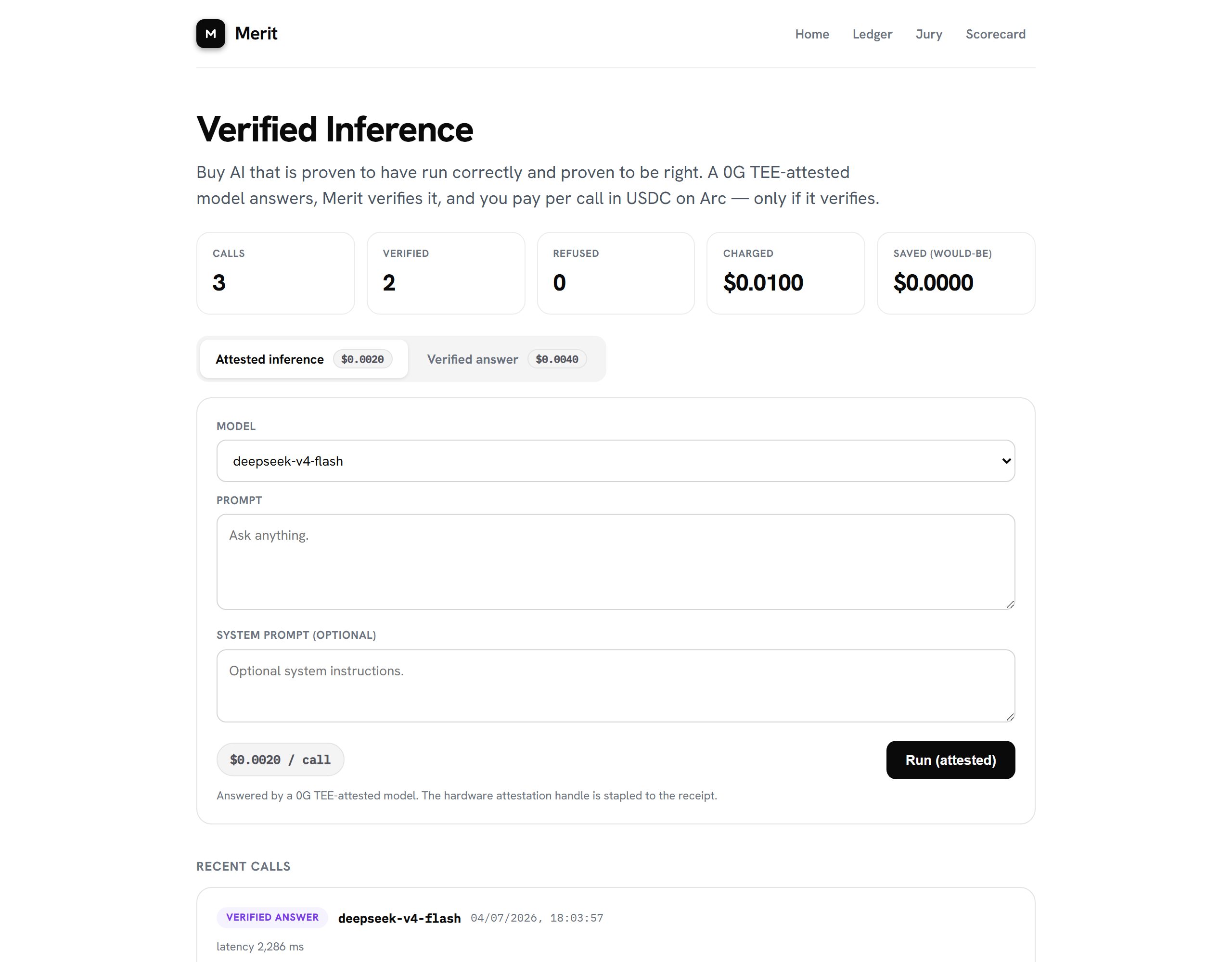
POST /api/toll/verify → SUPPORTED release $0.002 · conf 0.987 · 4 gates · signed · contradicted figure → REFUSE $0Resells the full live 0G roster — 13 TEE-attested chat models + a vision model, both trust modes and both API surfaces — and routes by pass-rate² ÷ price, not cheapest.
POST /api/inference {route} → picked deepseek-v4-flash · SUPPORTED · attested from 13 models0G's attested vision model reads a figure from an image; Merit grounds the answer in the model's own transcription — a fabricated figure is refused by the same numeric gate.
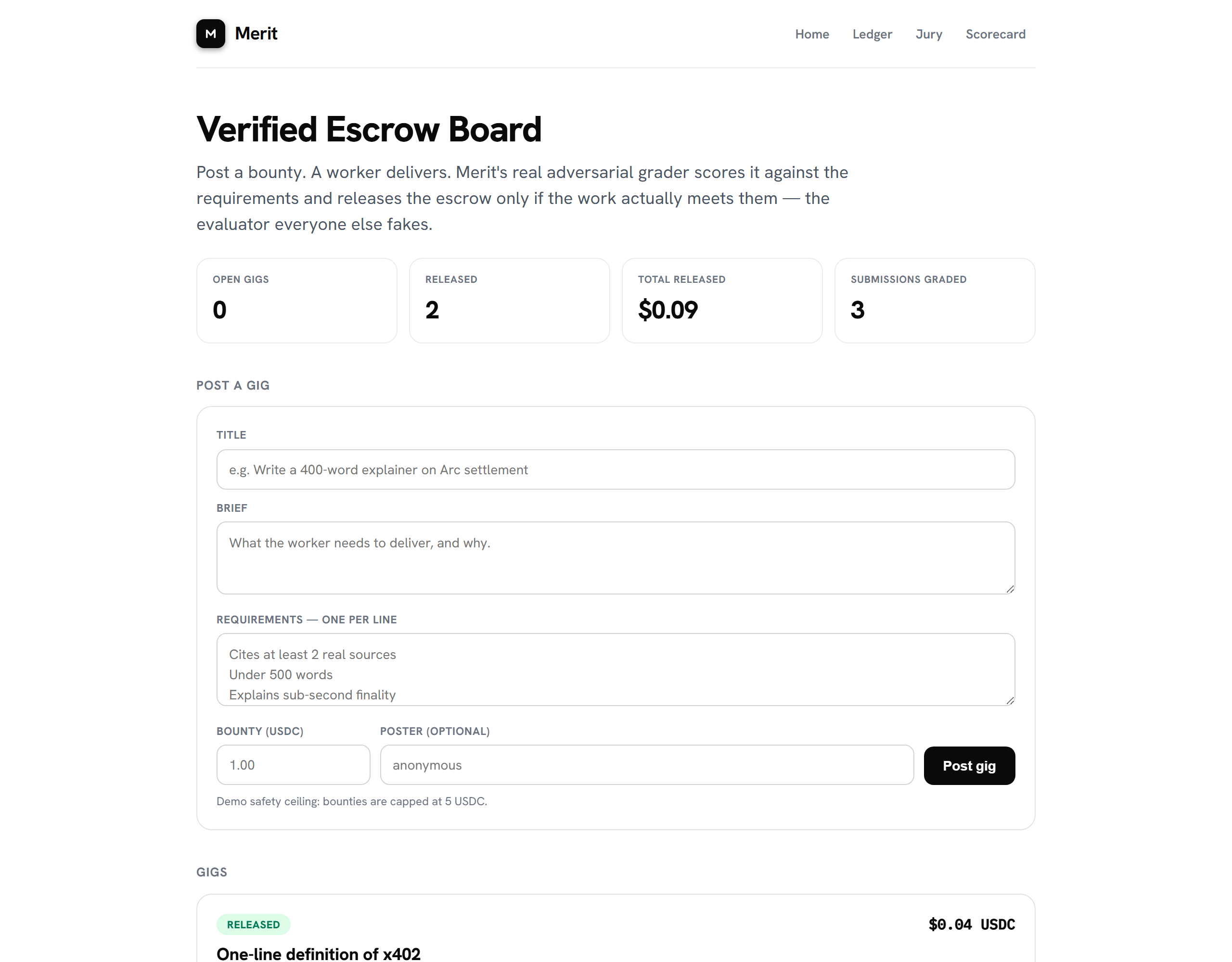
POST /api/inference {tier:vision} → read "42B" → SUPPORTED + TDX-attestedThe reusable evaluator any external escrow drops into the ERC-8183 evaluator slot: a signed accept/reject certificate its own hook settles on. Merit doesn't hold the escrow; a dispute is a deterministic re-grade.
POST /api/evaluator → on-brief release $0.05 · off-brief refund $0Pay any x402 seller, but keep the payment only if the delivered work verifies — a signed keep/dispute verdict on the content you paid for. A rail that pays on HTTP-200 trusts blindly.
POST /api/facilitator → keep on verified · dispute on unsupported · reuses payAndFetchSample an AI output's claims against a licensed source and flag misattribution — the audit layer bulk AI-licensing deals (OpenAI/Meta with publishers) lack.
POST /api/license/audit → 2 claims → 1 supported, 1 misattributed → signed royalty-true-up reportRanks buyable sources by verified quality per dollar and pays only the first whose delivered content actually verifies.
POST /api/buy → bought StableData $0.00531 · SUPPORTED · $0 wasted on a pay-on-delivery railA human-signed Intent→Payment mandate is a precondition of the gate: clears only when authorized AND verified.
POST /api/mandate/settle → authorized ✓ · verified SUPPORTED · cleared · bad signature → 403Dry-runs the transfer against Arc before broadcast, so a doomed payout is caught before it spends gas.
POST /api/simulate → wouldSucceed:false · "insufficient USDC: 16.85 < 999999"Authorize a basket of N cited lines; settle only the verified subset, quarantine the rest.
POST /api/settle/batch → verified subset settled, unverified quarantinedA portable, on-chain track record from release-vs-refund history; stronger records price higher.
GET /api/reputation/stabledata → merit 95 · portable release-rateA public directory + x402 manifest so an agent shortlists by a signal a price/latency listing can't emit.
GET /api/directory → 21 sources ranked by verified-quality-per-$Pay-per-tick with numeric-tier checkpoints — the stream auto-halts and refunds on quality drift.
POST /api/stream → per-tick settle · auto-halt + refund on driftFund once; burn down only on verified citations — refused ones are free — over gasless x402.
POST /api/verify/balance → burn-down only on verified · refused = $0A short-lived verify-only key spends the parent's balance up to a cap, and can be used nowhere else.
POST /api/session → scoped key · 403 at any other endpointOn a verified settlement, mints a signed, offline-recoverable proof-of-satisfaction a downstream rail can gate on.
POST /api/fulfillment → signed merit.fulfillment/v1, recovers offlineVerify an external seller's delivered content vs the claim; firewall hosts below the verified-delivery bar.
/api/procure + /api/sellers → verify delivery · firewall low-rep hostsA second settlement predicate: kill-switch, daily hard cap, and velocity auto-freeze on the settlement path.
/api/admin/freeze → one-call freeze · daily cap · velocity auto-haltSigned events on settle/refund whose payload carries the settlement reason — settled-because-verified vs refunded.
/api/webhooks → signed events + the settlement reasonA proven (claim+source) is never re-verified or re-paid; re-verifies automatically when the source changes.
reuse the signed verdict · re-verify on source change — the margin engineLearns its payout threshold from appeals while the decision stays gold-set-safe.
/api/learn → calibrates payout from appeals · decision untouchedThe verifier as an MCP tool (verify_citation) any agent installs via npx — pay only if the citation verifies.
verify_citation over MCP → signed verdict inlineScored on a public gold set. Every settlement on a live ledger.
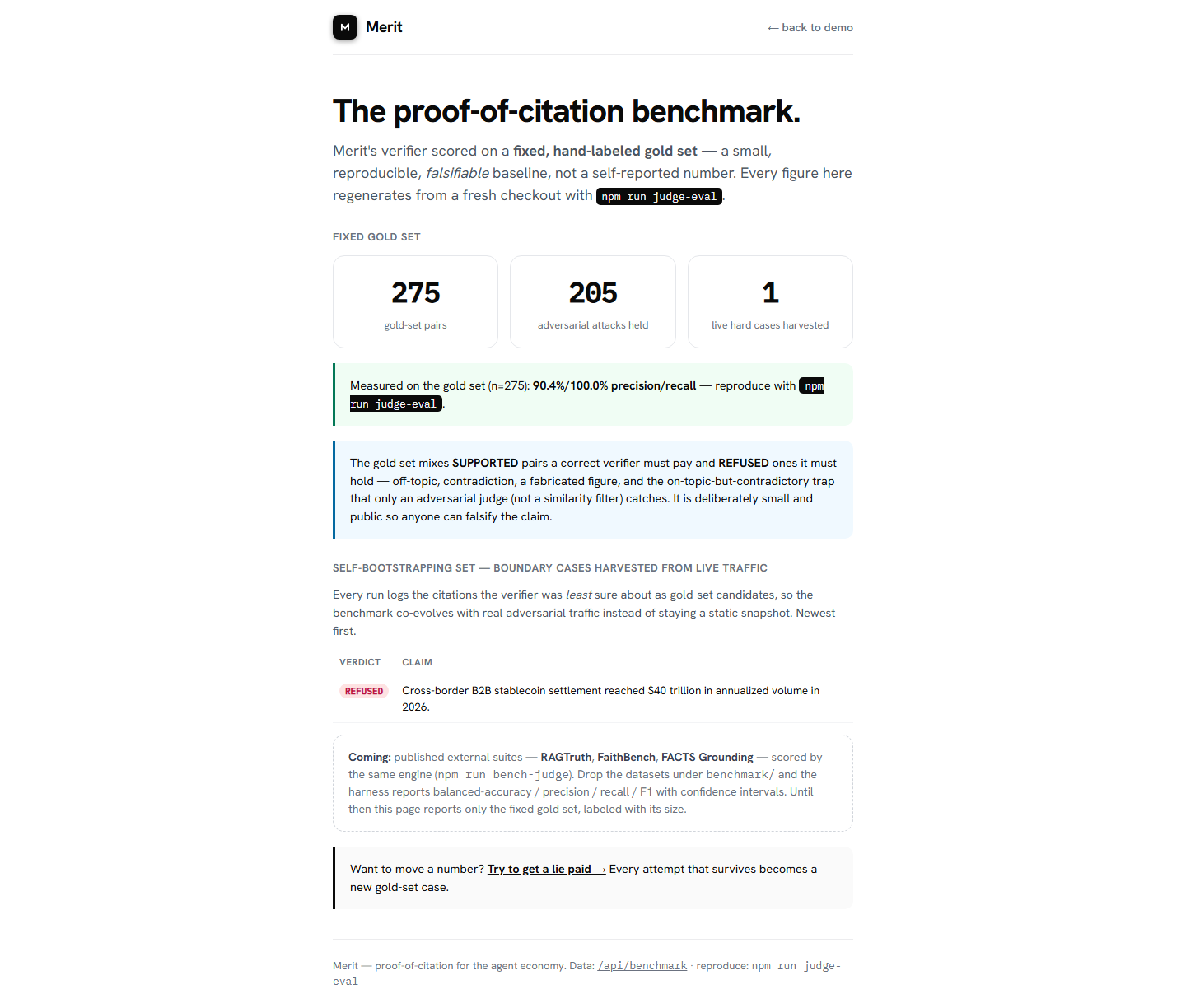
The verifier is measured on a fixed, hand-labeled gold set — reproducible from a fresh checkout, not a self-reported number — and co-evolves with live adversarial traffic. Every real settlement lands on a public ledger where each row is a signed receipt, most deep-linking a real Arc transaction.
Open any transaction and verify it yourself.
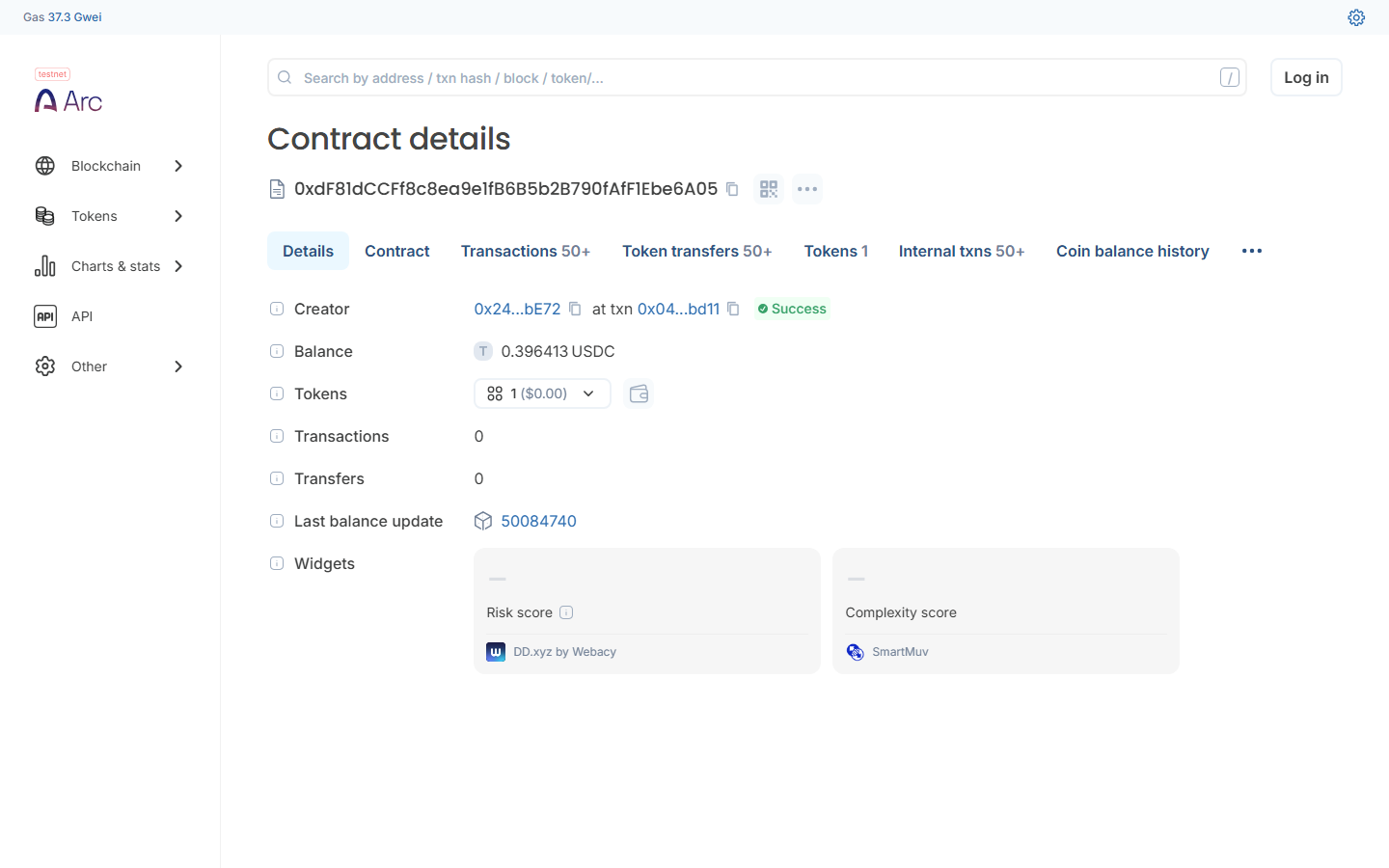
The proof-of-citation hook lifecycle, twice — a verified job that released and a failed job that reverted then refunded. Every hash has a successful receipt on Arc testnet 5042002. Click through to ArcScan.
Verified → RELEASED MeritJob #50
- createJob:0x4e927267…
- setBudget:0xe40245ba…
- approve USDC:0xb6b230a9…
- fund escrow:0xb41a210a…
- submit:0x8145553f…
- recordVerdict(✓):0xf79015a8…
- complete → release:0x6eda6b57…
Failed → REVERTED → REFUND MeritJob #51
- createJob:0x504a7e2a…
- fund escrow:0x595fdcc6…
- recordVerdict(✕):0x1f7ee799…
- complete():reverts — hook NotVerified gate
- reject → refund:0x629db6f7…
Deployed contracts Arc testnet 5042002
- MeritJob (ERC-8183):0xdF81…6A05
- VerificationHook:0xA30f…9ab1
- Escrow:0xbCaE…03Cd8
- USDC:0x3600…0000
Real · Arc mainnet Agent Credit — advance + repayment
- stake (0.02 USDC):Stake.sol ↗
- advance $0.005:0xc8d17a1d…
- repayment:0x2bb07ae0…
- verified:by decoding the real Transfer direction, not a trusted hash
Real · Arc testnet Agent Credit — overdue default → slash
- stake before:30000 atomic units (0.03 USDC)
- slash tx:0x074899…
- stake after:25000 atomic units (0.025 USDC) — independently confirmed via cast call stakeOf
Real · Arc testnet Global Payouts — EURC transfer
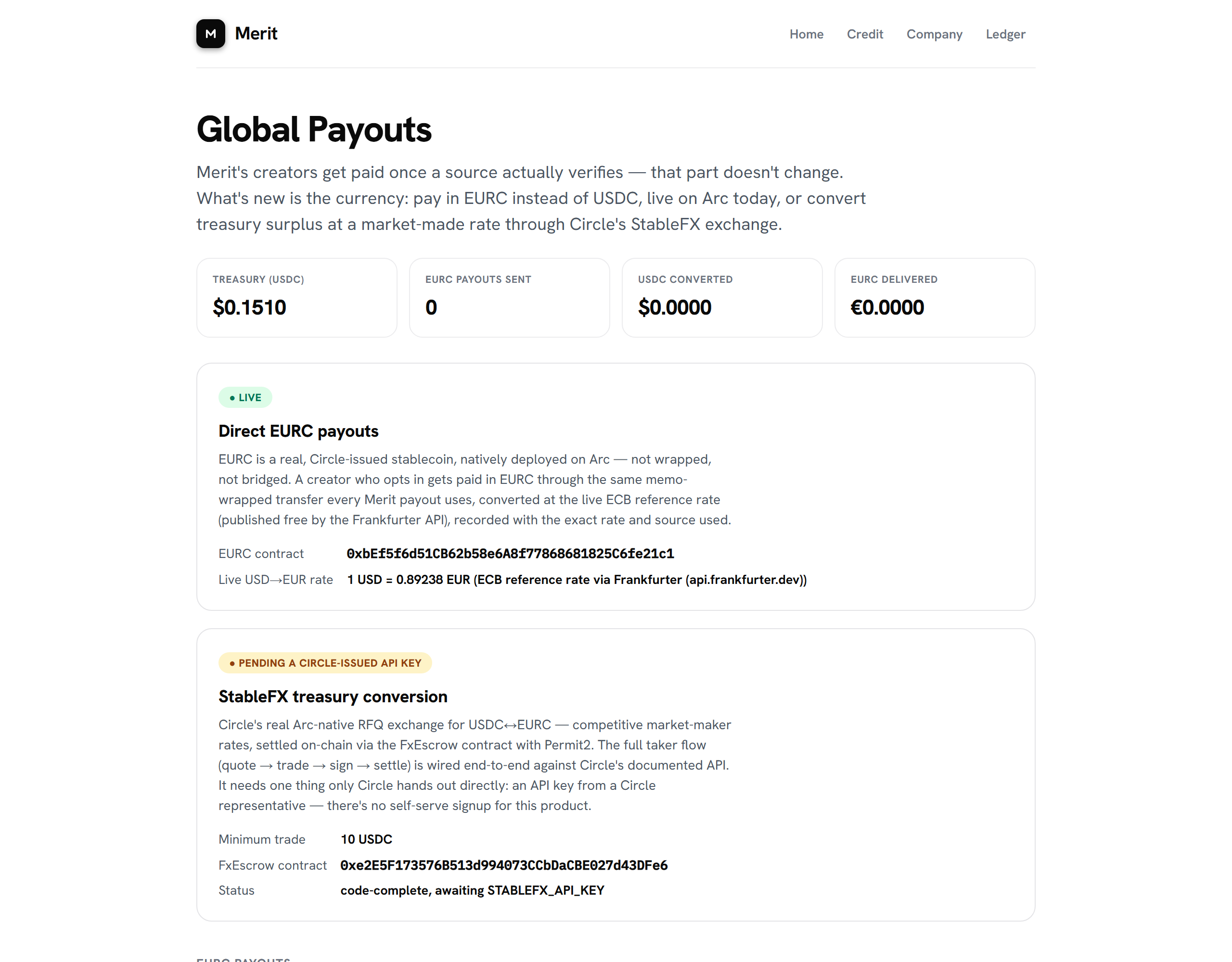
- owed:$0.02 USDC, converted at the live ECB rate (0.89238, Frankfurter)
- sent:0x266b3d10… — 0.017848 EURC
- verified:balanceOf before/after independently confirmed
Deployed contracts Arc mainnet 5042
- Stake:0xbb2b…260F
- MeritJob:0x0A76…0E554
- EURC:0xbEf5…fe21c1
- FxEscrow:0xe2E5…3DFe6
- USDC:0x3600…0000 (native, same address as testnet)