Architecture
x402 settles how an agent pays. x401 settles who authorized it. Neither checks whether the work was correct. Merit verifies that a cited source actually supports the claim made from it, and makes that verdict the settlement switch.
Everything below is deployed and exercised on Arc testnet. Every address and behaviour was verified against the live chain, not read off a datasheet. The source for these diagrams is docs/ARCHITECTURE.md.
1 · System
Who calls Merit, what happens inside it, and which Circle and Arc primitives carry the money.

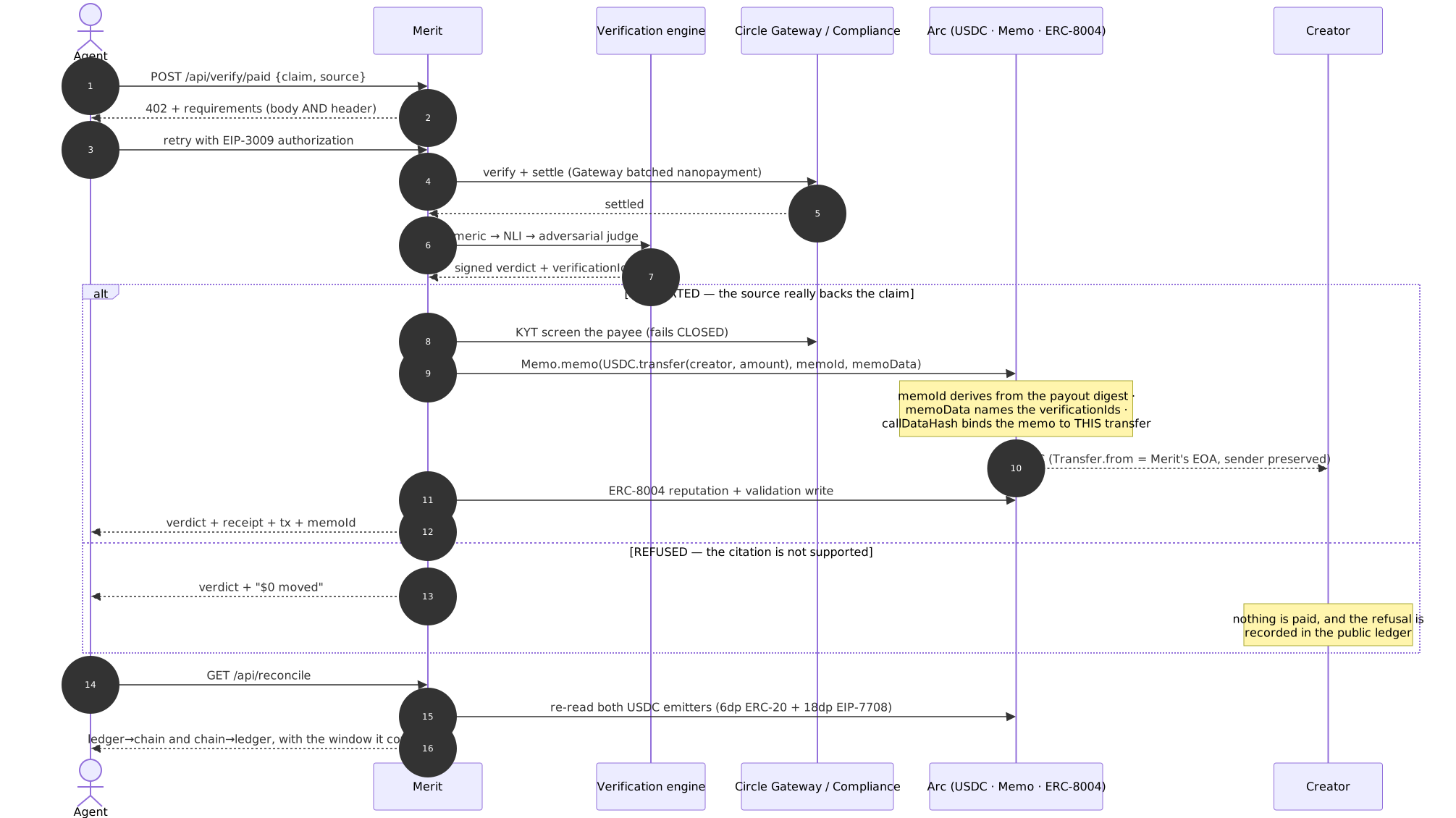
2 · The money path
The sequence that distinguishes Merit from every other rail: the payment is conditional on the work being right, and the proof of that condition travels inside the transaction.
3 · Verification engine
Price scales with how hard the check tries, never with retrieval. The first gate uses no model at all — which is why a fabricated figure is still caught when every LLM provider is down.

Measured, not asserted. A forkable 275-case adversarial benchmark across 14 failure modes: 100% recall — every adversarial case caught, 197 held, 0 slipped — at 90.4% precision / 94.9% F1. The verifier is conservative by design: it over-refuses roughly 30% of genuinely-supported claims rather than risk paying for one that is not. That is the safe direction when the output is money. Reproduce with npm run bench-judge.
4 · Network configuration
Arc mainnet launched (chain 5042) — most addresses Merit needs are published and verified live, but the ERC-8004 registries and Merit's own 7 contracts are not yet on mainnet. So Merit treats the network as configuration and invents nothing.

tests/arc-network.test.ts.5 · Where each Circle and Arc product is used
| Product | Where | What it does here |
|---|---|---|
| Arc | everywhere | Settlement chain. USDC-native gas, sub-second finality. |
| USDC | lib/pay.ts · lib/custody.ts · lib/balance.ts | The unit of account for every toll, payout and refund. |
| Circle Gateway / Nanopayments | lib/seller.ts · lib/pay.ts | x402 batched sub-cent tolls — Merit is both seller and buyer. |
| Circle Developer-Controlled Wallets | circle-dcw/ · lib/wallet.ts | KMS-custodied payout wallet; no plaintext key on the server. |
| Circle Compliance Engine | lib/compliance.ts | KYT + denylist screen before any payout. Fails closed. |
| CCTP | lib/crosschain.ts | A creator takes verified earnings to Base / Arbitrum / Optimism / Avalanche. |
Arc Memo | lib/memo.ts | The verdict travels inside the payment as an indexed on-chain event. |
Arc Multicall3From | lib/custody.ts | k creators paid in one transaction, msg.sender preserved per line. |
| EIP-7708 system emitter | lib/reconcile.ts | Independent second witness for every USDC movement, at 18 decimals. |
| EIP-3009 | lib/relay.ts | Gasless funding — the payer signs, Merit broadcasts and pays the gas. |
| ERC-8004 | lib/reputation.ts | Identity, reputation and validation registry writes — Merit fills the empty third slot. |
| ERC-8183 + IACPHook | contracts/ · lib/job.ts | Escrow whose release is gated on the citation verdict, on-chain. |